Commercial aerial photography has become a powerful tool for retail brands and event organizers looking to stand out in competitive markets.
From store launches and pop-ups to large-scale live events, drone visuals communicate scale, energy, and professionalism in ways ground-level photography cannot.
At GCES, commercial aerial photography is designed specifically for marketing use cases, not hobbyist footage.
At GCES, commercial aerial photography is built for marketing use, not hobbyist footage. This guide breaks down how pricing, compliance, and partner selection work so your brand can make informed decisions without taking on unnecessary risk.
What Makes Commercial Drone Photography Different from Standard Event Coverage?
A commercial drone shoot carries paperwork and safety compliance requirements that normal event coverage never touches. That alone makes it a different kind of purchase. In fact, a retail or event drone shoot is really two purchases pretending to be one.
You are buying footage, and you are buying the absence of a problem at your venue.
The footage is what shows up in the deck. The absence of a problem is what you actually lose sleep over: a venue turning away an uninsured pilot, or a no-show on the morning of a grand opening you only get to open once.
This guide walks through pricing first, because that is usually the first question.
Compliance and safety come next, because they decide whether the shoot happens at all.
Contracts and provider selection close it out, and that last stretch is where the brand risk either gets handed to you or kept away from you.
If you already know you need a partner, skip ahead and request a quote.
Affordable Commercial Drone Photography Packages for Retail Businesses

Retail brands increasingly rely on aerial photography to showcase storefronts, shopping centers, and customer flow, especially for digital advertising, Google Business listings, and launch campaigns.
At GCES, the most common retail use cases include:
- New store and flagship openings
- Shopping mall and mixed-use property overviews
- Location-based ad creatives
- Seasonal retail promotions
Affordability in commercial drone photography is not about choosing the lowest price. It’s about securing scalable, reusable content that works across paid media, social, and on-site displays.
GCES structures retail packages to balance cost efficiency with commercial requirements, typically including a defined flight window, professionally edited deliverables, and marketing-ready content.
Our Drone Packages:
For retail chains, GCES offers multiple packages that ensure visual consistency across multiple locations while reducing per-store costs. Most retail work falls into three package tiers.
Single Location Shoots:
Monthly Content Retainer
Multi-store Rollouts:
A multi-store rollout applies the same look across many locations on one scope, which gives you consistency from store to store, a lower per-site cost, and one point of contact instead of a different local operator in every city.
Monthly Content RetainerA single-location shoot covers one storefront, one flight window, a defined set of edited stills, and a short vertical cut. It fits a single opening, a rebrand, or a fresh set of Google Business and ad visuals.
A monthly content retainer is an always-on arrangement for brands shooting often enough that one-off booking gets expensive, covering seasonal promos, new openings, and refreshed creative on a predictable cadence.
You can save money without cutting the parts that protect you. Book multiple locations at the same time. Brief every deliverable up front so a scheduled shoot produces stills, vertical cuts, and a hero frame rather than one format you have to reshoot later on. What you should not cut is insurance, licensing, or the edit, because that is where a cheap number turns into an expensive problem.
Why Multi-store Rollout Model Matters for Chains?
The reason the rollout model matters for chains is simple math. A drone shoot has a fixed cost that has little to do with how many storefronts you shoot: the planning, the licensed crew, the insurance, the edit pipeline. Spread that across one location and the per-store number looks high. Spread it across forty and it drops, while every location comes back looking like it belongs to the same brand. If you run a multi-location brand, our photo and video production team can scope rollout pricing that keeps every store visually consistent.
Commercial Aerial Photography Pricing Models Explained
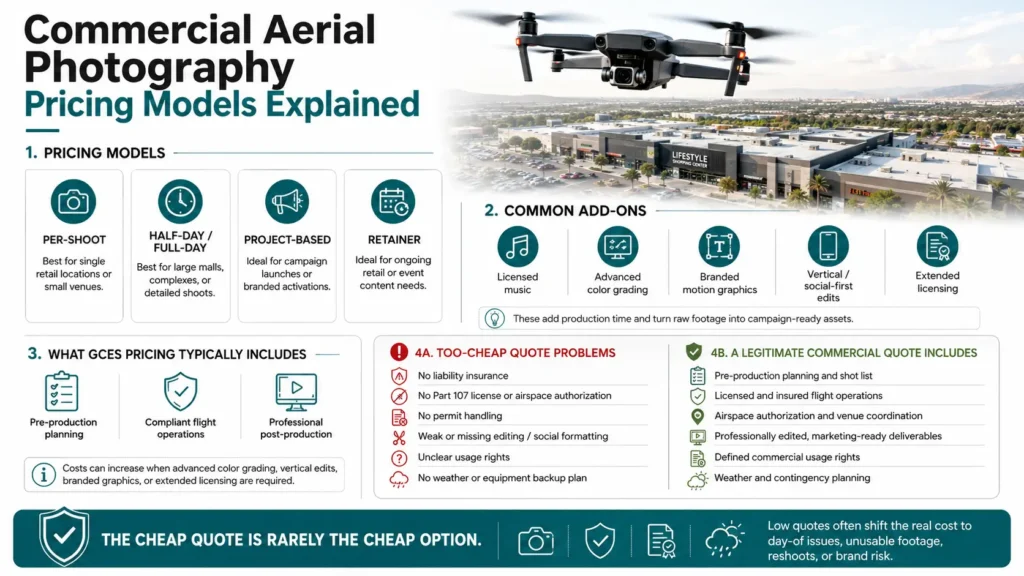
Commercial aerial photography pricing reflects the complexity, risk level, and intended usage of the footage.
Three models cover almost every retail and event scenario. The right one depends less on your budget than on how often you shoot and how big the site is. Per-shoot pricing suits single retail locations or small venues. Half-day or full-day rates suit large malls, complexes, or detailed shoots. Project-based pricing suits campaign launches or branded activations. A retainer suits ongoing retail or event content needs.
Add-ons sit on top of the base model. Licensed music, advanced color grading, branded motion graphics, and vertical or social-first edits each add cost because each adds production time. None of them are padding. They are the difference between a raw clip and an asset that drops straight into a campaign.
GCES pricing typically includes pre-production planning, compliant flight operations, and professional post-production. Costs may increase when advanced color grading, vertical social edits, branded motion graphics, or extended licensing are required.
As a rule, GCES advises brands to be cautious of quotes that seem unusually low, as they often exclude insurance, permits, or proper licensing, creating downstream risk.
The Too-Cheap Quote problems:
A too-cheap quote tends to leave out the things that protect you: liability insurance, a Part 107 license or airspace authorization on file, permit handling for the location, any real edit or color or social formatting, clear usage rights, and a backup plan if weather or equipment fails.
A legitimate commercial quote includes pre-production planning and a shot list, licensed and insured flight operations, airspace authorization and venue coordination, professionally edited and marketing-ready deliverables, usage rights defined for commercial marketing, and weather and contingency planning built in.
The cheap quote is rarely the cheap option. A low number usually means the cost did not disappear. It moved. It moved to the day-of scramble when the venue refuses an uninsured operator, to the reshoot when the footage comes back unusable, or to the brand’s reputation when something goes wrong at a public event.
What Are the Legal Requirements for Commercial Aerial Photography in the US?

Commercial drone operations in the US are regulated by the Federal Aviation Administration (FAA). Any drone footage used for advertising, marketing, or events must comply with federal aviation rules.
GCES operates under full FAA Part 107 certification, with insured pilots and documented operational procedures. Depending on the location, GCES also manages airspace authorization, venue coordination, and any additional approvals required for retail environments or live events.
For brands, working with GCES removes the burden of navigating regulatory complexity and reduces the risk of last-minute cancellations or compliance issues.
The phrase “must comply with federal aviation rules” covers more than one requirement. For a retail or event shoot, these are the pieces that have to be in place before a drone is legal to fly for commercial use:
- A current FAA Part 107 certificate held by the remote pilot. That is the baseline separating commercial operation from hobbyist flying.
- Airspace authorization, often through LAANC, since many retail and event locations sit in controlled airspace near airports. It gets secured before the shoot, not on the day.
- Liability insurance at the level the venue requires, with the venue named where they ask for it.
- Permission from the property, plus a flight plan that accounts for people on the ground.
- Any night or event-specific approvals. Evening activations and crowded events carry extra requirements that have to be planned for in advance.
The reason this matters to a marketer rather than a pilot is that the consequences land on the brand, not the operator. An uninsured or unauthorized flight that gets stopped at the door costs you the footage and, worse, the only window you had at a one-time event.
Guides for Commercial Aerial Photography Safety & Compliance Standards

Safety is a core component of GCES’s commercial aerial operations, particularly in environments involving customers, staff, or live audiences.
Each GCES project includes pre-flight risk assessments, coordination with venue or event teams, controlled flight paths, and continuous monitoring of weather and on-site conditions. Post-flight, footage is securely handled and delivered according to agreed commercial standards.
These safeguards protect the public, the venue, and, most importantly, the brand commissioning the work.
For a brand booking its first event shoot, here is what professional safety looks like in practice, in the order it happens:
- A pre-flight risk assessment. Before the date, the operator maps the site, the airspace, the crowd areas, and the ways a flight can go wrong.
- On-site coordination, where the crew briefs venue and event staff so security, stage managers, and the drone team work from the same plan.
- Crowd-safe flight paths, routed to avoid flying directly over people, with clear zones marked out.
- Weather thresholds set in advance, so a wind or rain call is a plan rather than a judgment made under pressure.
- Post-flight footage stored and delivered to the commercial standard the contract specifies.
None of this is visible in the final edit. All of it is the difference between an activation people remember for the right reason and one that ends up in a liability conversation. The reason this earns a section of its own is that the cost of getting it wrong does not land on the pilot. It lands on the brand, in event safety, in liability, and in reputation.
Benefits of Using Commercial Aerial Photography for Marketing Campaigns

GCES clients use aerial photography to enhance campaign performance across multiple channels.
Aerial visuals help retail and event brands:
- Increase engagement in paid social and video ads
- Raise perceived production value and brand credibility
- Communicate scale and atmosphere instantly
- Create hero assets for landing pages and DOOH placements
Because GCES shoots with marketing use in mind, footage is filmed and edited for reuse, allowing a single shoot to support weeks or months of campaign activity.
Aerial content tends to earn its place in a few specific channels. On Meta, it works in Reels and Stories, where overhead reveals stop the scroll better than ground shots. It works as YouTube pre-roll and as the hero banner on a landing page, the highest-impression placements a brand owns. And it suits DOOH, the digital out-of-home and billboard placements that need a frame with real scale. One shoot, formatted correctly, feeds all of them.
The reuse point is the one that changes the budget conversation. A shoot that produces a single horizontal video is a cost. A shoot that produces a horizontal master, vertical social cuts, square feed posts, still frames for the Google listing, and a hero banner for the landing page is an asset that works for months. Same flight. The difference is whether the brief asked for the formats up front.
Examples of Commercial Aerial Photography Used in Advertising Campaigns

GCES supports retail brands and event organizers by producing aerial visuals that:
- Build anticipation ahead of store launches or events
- Show energy and attendance during live activations
- Extend campaign visibility after the event concludes
Common outputs include exterior flyovers, crowd-safe overhead shots, and dynamic establishing visuals that can be repurposed across social, paid media, PR, and on-site displays.
The campaign arc usually breaks into three phases. Before the event, pre-launch flyovers and teaser cuts signal that something is coming; a construction-to-reveal sequence or an empty-venue establishing shot primes the audience before doors open. During the event, crowd-safe overhead shots show attendance and atmosphere as it happens, which is the footage that proves the activation worked and the footage sponsors want to see. After the event, recap edits, PR stills, and establishing visuals keep the campaign alive once the crowd goes home, so the shoot keeps paying out long after the event is over.
A useful way to brief any of these is to state the campaign objective, plan the aerial execution against it, and define the outcome you are chasing, whether that is engagement, visibility, or reach. The structure holds whether it is a retail grand opening, a festival, a mixed-use property launch, or a seasonal push. This is also where GCES case visuals slot in once a specific campaign is cleared to feature; you can see prior work in our 360 Drone portfolio.
How to Negotiate Contracts with Commercial Aerial Photography Providers

Clear contracts are essential for smooth collaboration. GCES contracts are structured to align with real marketing workflows rather than restrictive or unclear licensing terms.
Before signing with any provider, get clear answers on five things, because these are where disputes start when they get left vague. Usage rights and licensing duration: where can you run the footage, on which channels, and for how long. Exclusivity: whether the operator can resell or reuse footage of your brand or venue. Deliverables and revision limits: exactly what files you receive, in what formats, and how many rounds of edits are included. The weather-and-reshoot clause, which tells you what happens if conditions ground the flight on the day. And cancellation terms, which tell you what it costs to move or cancel, and by when.
The GCES approach maps to each of these. Usage rights are defined for commercial marketing use. Deliverables are clearly scoped and agreed from day one. Weather clauses come with transparent reshoot policies. And timelines are aligned to campaign needs rather than left open.
This approach helps brands avoid surprises and ensures the footage can be used where it matters most.
Top-Rated Commercial Aerial Photography Firms for Event Coverage
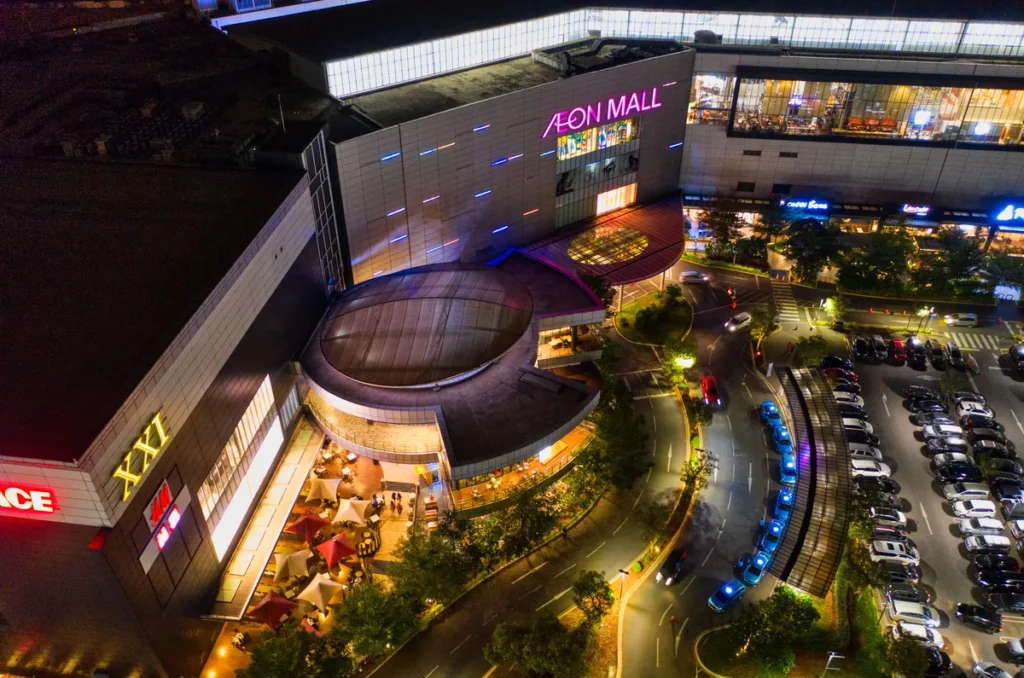
Retail launches and live events require more than drone skills. GCES brings experience in venue coordination, crowd-safe operations, and fast post-event turnaround, which is critical for brands that need content immediately after an activation.
Brands choose GCES for:
- Experience in retail and event environments
- Strong safety and compliance processes
- Marketing-first deliverables
- Reliable execution under real-world conditions
The skill of flying a drone is the easy part to find. Plenty of operators can produce a clean shot. What separates a provider you can put in front of a live audience and a paying client is everything around the flight.
A top-tier provider can show real event flight experience, because flying over a crowd is a different job from flying over an empty field, so ask how many live events they have actually run. They work from documented crowd-safety protocols rather than improvisation. They can coordinate a live event with venue security, stage managers, and the other vendors on the day. They treat post-event turnaround as part of the deliverable, since footage that lands a week late has missed the moment. And they arrive insured and legally ready, with COIs and authorizations handled before the date, not chased the morning of.
That readiness is why brands bring GCES in for retail activations, corporate events, and large-scale public experiences. If you are weighing providers, you can start a conversation with a commercial drone specialist.
Choosing a Commercial Drone Partner That Scales With Your Brand

Across pricing, compliance, safety, and creative impact, the throughline is the same. The footage is only half of what you are buying. The other half is a shoot that actually happens, at a venue that lets the pilot fly, with content that holds up across every channel you plan to run it on.
Commercial aerial photography is about more than the footage itself. It’s about protecting brand reputation while delivering content that performs. Cutting corners rarely saves money; it moves the cost to the day of the shoot, the reshoot, or the brand’s reputation, and usually makes it bigger.
GCES combines compliant flight operations, commercial-grade production, and marketing-focused delivery to help retail brands and event organizers run their campaigns with confidence.
FAQ
How much does commercial aerial photography cost for retail or events?
There is no flat rate. Pricing depends on how complex the shoot is, the risk level of the location, and how the footage will be used. Most work falls into one of four models: per-shoot, half-day or full-day, project-based, or an ongoing retainer. A legitimate quote covers pre-production planning, compliant flight operations, and professional editing. Treat an unusually low quote with caution, since it often leaves out insurance, permits, or proper licensing.
What are the legal requirements for commercial drone photography in the US?
Commercial drone operations in the US are regulated by the FAA, and any footage used for advertising, marketing, or events has to comply with federal aviation rules. In practice that means a licensed Part 107 pilot, airspace authorization where the location requires it, and adequate insurance. GCES handles all of this, operating under full Part 107 certification with insured pilots and managing airspace authorization and venue coordination for each shoot.
Is it safe to fly a drone at a live event with crowds?
Yes, when the work is handled by an experienced commercial operator. Every GCES shoot starts with a pre-flight risk assessment and includes coordination with venue and event staff, controlled flight paths that keep the drone clear of people, and ongoing monitoring of weather and on-site conditions. The aim is to protect the public, the venue, and the brand running the activation.
How long does it take to get footage after an event?
Turnaround is agreed before the shoot, not left open. For most retail and event work, GCES delivers marketing-ready edits within the window the campaign needs, and faster options are available for activations where content has to go live right after the event. Setting the deadline up front is what makes a quick turnaround dependable rather than a last-minute scramble.
Who owns the footage, and how can it be used?
Ownership and licensing are written into the contract, so they are clear from the start. GCES defines usage rights for commercial marketing use, which lets the footage run across social, paid media, PR, and on-site displays. Details like exclusivity and how long the rights last are agreed in advance, so brands know exactly where and for how long they can use the content.
This guide is general information for marketers, not legal or regulatory advice. FAA rules, airspace authorizations, and insurance requirements change and vary by location and venue. Confirm current requirements for your specific shoot with a licensed operator before booking.